Sight
Soften your gaze
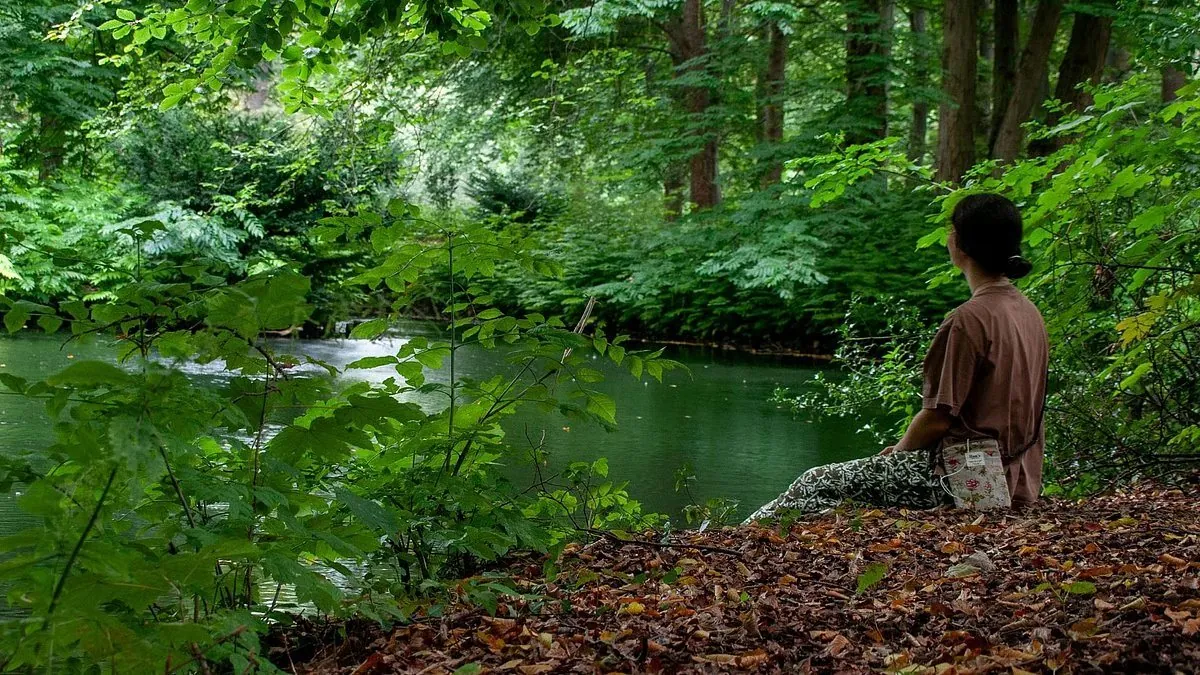
Stop looking for things. Let the eyes rest on the layers of green, the light through the canopy, the way a leaf moves.
What it is
The word was coined in 1982 by Tomohide Akiyama, then director of Japan's Forestry Agency, to invite people back into the country's forests. Researchers in Japan have studied what happens to people there ever since.
"Bathing" is the point. You do not hike the forest or study it. You soak in it, the way you would in water: slowly, without a goal, until you stop noticing the time.
It is
It is not
The art of it
There is no technique to master. The practice is a change of pace, and then a turning of attention to each sense in turn.
Sight
Stop looking for things. Let the eyes rest on the layers of green, the light through the canopy, the way a leaf moves.
Sound
Wind in the high leaves, water somewhere, a bird you cannot see. Listen until you hear the sound beneath the sounds.
Smell
Wet soil, crushed leaf, wood, rain on bark. Slow, full breaths, in through the nose.
Touch
Moss, bark, cool stone, running water. Bare hands on the forest, and the ground under your feet.
Taste
Tea made from local plants, drunk slowly at the end. The forest, taken in.
A few hundred metres in an hour is enough. Slower than you think you should.
Follow what draws you. Stop when something asks you to.
Find a place and stay in it. Most people say this is where the forest begins.
Put the phone away and let silence do the work. You do not need to say anything.
What it does to the body
Forest bathing has been studied for more than thirty years, mostly in Japan, Korea and Europe. Some findings are consistent. Others are early. We state both.
Most consistent
In a review of 28 trials, scores for anxiety, depression, fatigue, anger and confusion fell after time in the forest, in many studies each, and vigour rose. This is the strongest finding.
Nervous system
Several studies measured heart-rate variability and found a swing from the body's alert state towards its rest-and-digest state. Pulse rate often fell with it.
Stress hormones
Saliva cortisol, the body's main stress hormone, was lower in several studies after forest walks or sitting in a forest. A 2019 pooled analysis of cortisol studies looked at the same question.
Mixed
Some trials found lower blood pressure after a forest visit. Others found no change. We do not claim it as a treatment.
Early
Some Japanese work has linked forest stays to higher natural killer cell activity, and suggests airborne plant compounds called phytoncides may play a part. Results across studies conflict, and most rest on single studies.
Dose
A survey of nearly 20,000 people in England found good health and wellbeing were more likely among those who spent at least 120 minutes a week in nature. It was an association, not proof of cause.
What it does to the mind
Most of the day asks for effortful, directed attention: screens, decisions, noise. A forest asks for none of it, and the mind gets to rest.
Two long-standing theories try to explain why. Attention Restoration Theory says natural settings hold our attention gently, through "soft fascination", which lets the tired, directed kind recover. Stress Reduction Theory says humans respond to natural scenes with an immediate calming of the body.
What people report matches both. The mental chatter slows. The sense of urgency drops. Small things get noticed again: the colour of a leaf, the rhythm of rain. After a session some people say they think more clearly, and sleep more deeply that night. These are reports, not measurements.
Both are theories, not settled laws. We offer them as a way of understanding what many people feel, not as promises.
Connecting with the earth
Beyond what can be measured, forest bathing is a way of re-entering a place. You learn what grows here and what it sounds like at dusk. You feel the season in your skin.
This part is felt, not measured, and we make no scientific claim for it. But it is what many people come back for: a sense of belonging to something larger and slower than a schedule.
In Kodagu the idea is not new. The Kodava keep devarakadu, sacred groves protected for generations as the dwelling of the forest's gods. We practise on that tradition's ground, and in its spirit of care.
Inside a session
Phones away. A few minutes at the forest's edge to land where you are.
Invitations rather than instructions: follow a sound, a smell, a patch of light.
Find a place and stay. This is usually where the forest starts to speak.
Tea shared in near-silence, brewed from what the region grows.
A short, optional circle to say what you noticed. Silence is also an answer.
Sources
Origin of the term and early Japanese research: Nippon.com, Miyazaki Yoshifumi. Systematic review of 28 trials: Medical empirical research on forest bathing (Shinrin-yoku), Environmental Health and Preventive Medicine, 2019. Cortisol: Effects of forest bathing on cortisol, a systematic review and meta-analysis, 2019. Weekly dose: White et al., Scientific Reports, 2019.
This page is for general information and is not medical advice.